
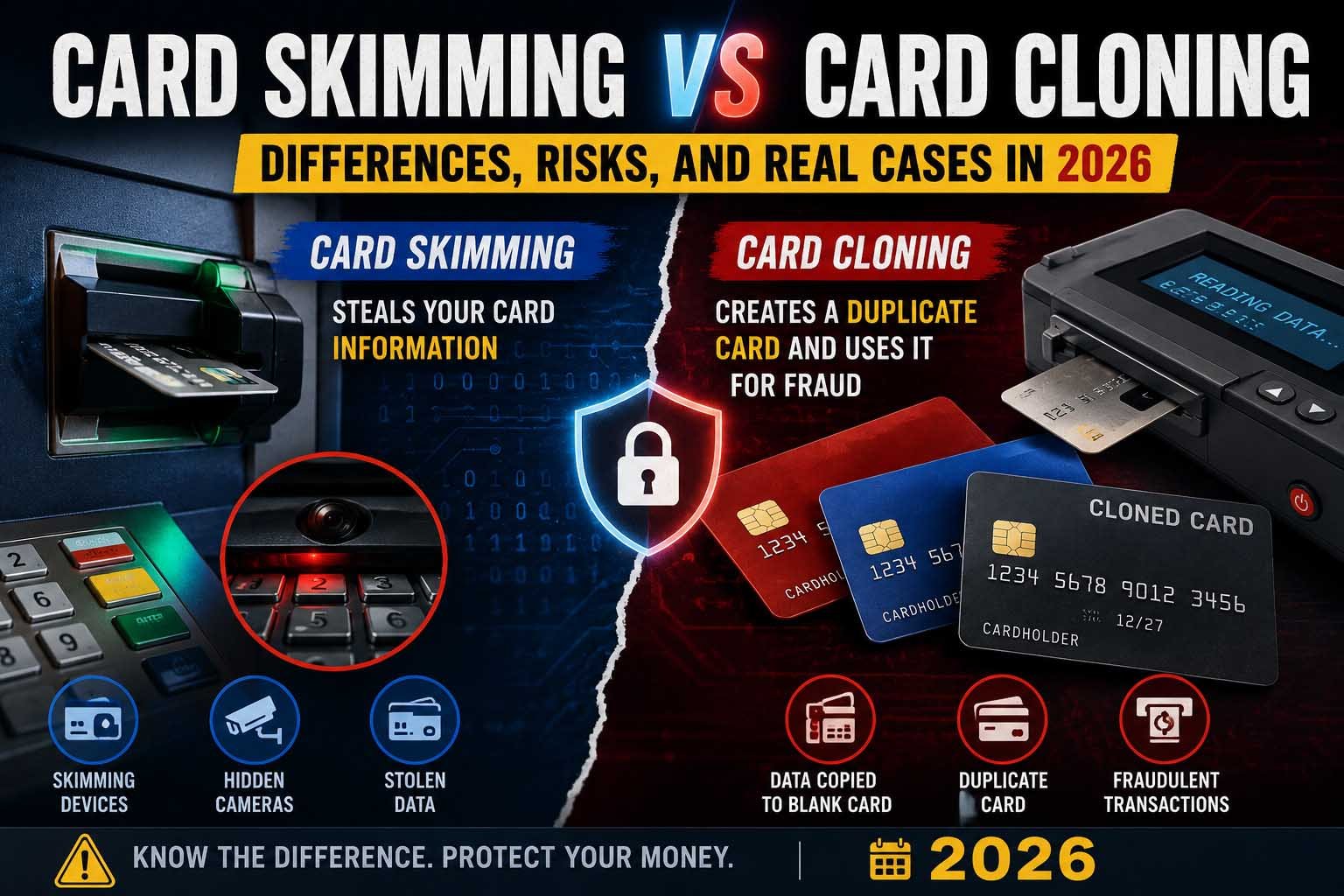
Card Skimming vs Card Cloning: Differences, Risks, and Real Cases in 2026

Card Skimming vs Card Cloning: Differences, Risks, and Real Cases in 2026
Financial fraud continues to evolve rapidly in 2026, with criminals using increasingly sophisticated methods to steal banking information and exploit unsuspecting victims. Among the most common payment fraud techniques are card skimming and card cloning. Although these terms are often used interchangeably, they are not exactly the same.
Understanding the differences between card skimming vs card cloning is essential for protecting your finances, personal data, and digital identity. Both crimes can lead to unauthorized withdrawals, stolen funds, damaged credit scores, and long-term identity theft issues.
In this guide, you will learn:
- What card skimming means
- What card cloning means
- The key differences between card skimming vs card cloning
- Major risks involved
- Real fraud cases from 2026
- Warning signs to watch for
- How to protect yourself from becoming a victim
What Is Card Skimming?
Card skimming is the process of secretly stealing payment card information using hidden devices known as skimmers.
These devices are commonly attached to:
- ATMs
- Gas station pumps
- Point-of-sale terminals
- Ticket machines
- Parking payment systems
When a victim inserts or swipes their card, the skimmer copies the information stored on the magnetic stripe or chip.
Criminals may also install hidden cameras or fake keypads to capture PIN numbers.
How Card Skimming Works
The skimming process usually follows these steps:
- Fraudsters install a hidden skimmer
- Victim uses the ATM or payment terminal
- Card data gets copied secretly
- PIN information is recorded
- Criminals use the stolen data for fraud
Card skimming is often the first stage that eventually leads to card cloning.
What Is Card Cloning?
Card cloning happens when stolen card information is copied onto another card to create a duplicate version.
Criminals use special encoding equipment to transfer stolen card data onto blank cards. These cloned cards can then be used for:
- ATM withdrawals
- In-store purchases
- Online shopping
- International transactions
Unlike skimming, cloning is the actual duplication process after data theft has already occurred.
Card Skimming vs Card Cloning: The Main Difference
The biggest difference between card skimming vs card cloning is their role in the fraud process.
| Card Skimming | Card Cloning |
|---|---|
| Steals card data | Duplicates the card |
| Uses skimming devices | Uses encoding equipment |
| Happens at payment terminals | Happens after data theft |
| Collects card information | Creates fake cards |
| First stage of fraud | Second stage of fraud |
In simple terms:
- Skimming is data theft
- Cloning is data duplication
The two crimes often work together.
Why Card Skimming and Card Cloning Are Increasing in 2026
Payment fraud has increased significantly in recent years due to technological advancements and expanded digital banking.
Several factors contribute to the rise of card skimming vs card cloning incidents in 2026.
1. Advanced Skimming Technology
Modern skimmers are much smaller and harder to detect than older devices.
Some are nearly invisible and can transmit stolen data wirelessly.
2. Increased Cashless Transactions
More consumers rely on debit and credit cards daily, creating more opportunities for fraud.
3. Weak ATM Security
Older ATMs still rely heavily on magnetic stripe technology, making them vulnerable to skimming.
4. Online Data Breaches
Massive corporate breaches continue exposing millions of payment records.
5. Growth of International Fraud Rings
Organized cybercrime groups now operate globally, making fraud investigations more difficult.
Common Places Where Skimming Happens
Understanding where skimming occurs can help reduce your risk.
ATMs
ATMs remain one of the most common skimming targets because criminals can steal both card data and PIN numbers.
Gas Stations
Outdoor fuel pumps are frequently targeted due to limited supervision.
Restaurants and Retail Stores
Portable payment terminals may be tampered with by dishonest employees or criminals.
Tourist Areas
Tourists are often targeted because they may not notice suspicious charges immediately.
Public Transportation Machines
Ticket kiosks and parking meters are increasingly targeted in urban areas.
Warning Signs of Card Skimming
Knowing the warning signs can help you avoid compromised machines.
Loose Card Readers
If the reader feels wobbly or bulky, it may contain a skimmer.
Hidden Cameras
Tiny cameras are often placed above keypads to record PIN entries.
Broken Security Seals
Damaged or missing seals can indicate tampering.
Unusual ATM Attachments
Fraudsters sometimes place fake fronts over ATM machines.
Sticky Keypads
Overlay keypads may record PIN numbers secretly.
If anything looks suspicious, avoid using the machine.
Warning Signs Your Card Has Been Cloned
Victims often realize their card has been cloned only after fraud occurs.
Unauthorized Purchases
Unknown transactions are one of the biggest warning signs.
ATM Withdrawals in Another Location
Cloned cards are commonly used to withdraw cash quickly.
Fraud Alerts From Your Bank
Banks may detect unusual activity before you do.
Declined Transactions
Your bank may freeze the card after suspicious activity.
Sudden Balance Changes
Unexpected account balance drops often indicate fraud.
Real Card Skimming and Cloning Cases in 2026
Case 1: Gas Station Skimming Ring
In early 2026, authorities uncovered a nationwide fraud ring targeting gas stations. Criminals installed Bluetooth-enabled skimmers inside fuel pumps across multiple cities.
Victims unknowingly exposed their card data while fueling vehicles. The stolen information was later used to create cloned cards for ATM withdrawals.
Thousands of dollars were stolen before the operation was shut down.
Case 2: Tourist ATM Scam
A tourist visiting Europe used an ATM located near a busy transportation hub. Hidden skimming equipment captured both the card data and PIN.
Within hours, cloned cards were used in another country for large cash withdrawals.
The victim only discovered the fraud after receiving bank notifications.
Case 3: Restaurant POS Fraud
A restaurant employee secretly used a handheld skimmer to copy customer card information during payments.
The stolen data was sold on underground cybercrime marketplaces, where other criminals created cloned cards for fraudulent purchases.
Over 200 customers were affected before investigators uncovered the scheme.
Risks of Card Skimming vs Card Cloning
Both crimes carry serious financial and personal consequences.
Financial Loss
Victims may lose large amounts of money through unauthorized transactions.
Identity Theft
Criminals sometimes combine payment fraud with stolen personal information.
Credit Damage
Fraudulent activity may negatively impact your credit profile.
Emotional Stress
Victims often experience anxiety and frustration while resolving fraud cases.
Account Freezes
Banks may temporarily freeze accounts during investigations.
Which Is More Dangerous: Skimming or Cloning?
When comparing card skimming vs card cloning, both are dangerous but serve different purposes.
Skimming is dangerous because it enables mass theft of payment information.
Cloning is dangerous because it directly allows criminals to spend stolen money.
Without skimming, cloning becomes more difficult. Without cloning, stolen card data may have limited use.
The crimes are interconnected.
How Criminals Avoid Detection in 2026
Modern fraud operations use sophisticated techniques.
Wireless Data Transmission
Bluetooth skimmers can send stolen information remotely.
AI-Assisted Fraud
Some criminal groups use artificial intelligence to analyze stolen financial data.
Cryptocurrency Payments
Underground markets often sell stolen card data using cryptocurrency.
Disposable Devices
Fraudsters use temporary equipment to avoid leaving evidence.
How Banks Fight Card Skimming and Cloning
Financial institutions continue improving fraud prevention systems.
EMV Chip Technology
Chip cards are harder to duplicate than magnetic stripe cards.
AI Fraud Monitoring
Banks use machine learning systems to detect suspicious spending patterns.
Real-Time Alerts
Customers receive instant notifications for unusual activity.
Biometric Verification
Fingerprint and facial recognition reduce fraud risks.
How To Protect Yourself From Card Skimming and Cloning
Use Contactless Payments
Tap-to-pay methods are generally safer than swiping cards.
Inspect ATMs Carefully
Always examine the card reader before use.
Cover Your PIN
Prevent hidden cameras from recording your PIN entry.
Avoid Isolated ATMs
Use ATMs inside banks whenever possible.
Monitor Your Transactions Daily
Frequent account checks help detect fraud early.
Enable Banking Alerts
Real-time notifications improve fraud detection speed.
Use Virtual Cards Online
Virtual cards reduce exposure during online shopping.
Replace Old Magnetic Stripe Cards
Chip-enabled cards offer stronger protection.
What To Do If You Become a Victim
If you suspect card skimming or card cloning, act immediately.
1. Freeze Your Card
Use your banking app or contact your bank directly.
2. Report Fraud Immediately
Quick reporting improves recovery chances.
3. Change Your Passwords
Update online banking and email passwords.
4. Request a Replacement Card
Do not continue using a compromised card.
5. File a Police Report
Official documentation may help during investigations.
6. Monitor Your Credit
Watch for identity theft signs after the incident.
The Future of Card Fraud Beyond 2026
Card fraud will likely continue evolving alongside financial technology.
Experts predict increased use of:
- AI-powered fraud systems
- Deepfake identity verification attacks
- Mobile payment exploitation
- Biometric spoofing
- Cross-border cybercrime networks
As fraud methods become more advanced, consumer awareness becomes even more important.
Final Thoughts
Understanding card skimming vs card cloning is essential in today’s increasingly digital financial world. While skimming focuses on stealing card data, cloning involves creating duplicate cards for fraudulent use.
Both crimes can lead to severe financial losses, identity theft, and long-term security risks. By learning the warning signs, monitoring your accounts, and practicing smart payment habits, you can significantly reduce your chances of becoming a victim.
In 2026, financial fraud continues evolving rapidly, but staying informed remains one of the strongest defenses available.
Frequently Asked Questions (FAQ)
What is the difference between card skimming and card cloning?
Card skimming involves stealing card information, while card cloning involves creating duplicate cards using stolen data.
Can chip cards still be cloned?
Chip cards are harder to clone than magnetic stripe cards, but criminals can still steal card data through advanced methods.
How do skimmers steal PIN numbers?
Fraudsters often use hidden cameras or fake keypad overlays to capture PIN entries.
Are contactless payments safer?
Yes. Contactless payments reduce physical interaction with card readers, lowering skimming risks.
How quickly should I report suspicious transactions?
Immediately. Fast reporting helps prevent additional fraud and improves refund chances.
Can banks detect cloned cards automatically?
Many banks use AI fraud detection systems that identify suspicious transactions in real time.
Where are skimming devices most commonly found?
ATMs, gas stations, parking meters, and payment terminals are common skimming targets.
What should I do if I find a skimmer?
Avoid using the machine and report it to the bank, business owner, or local authorities immediately.

